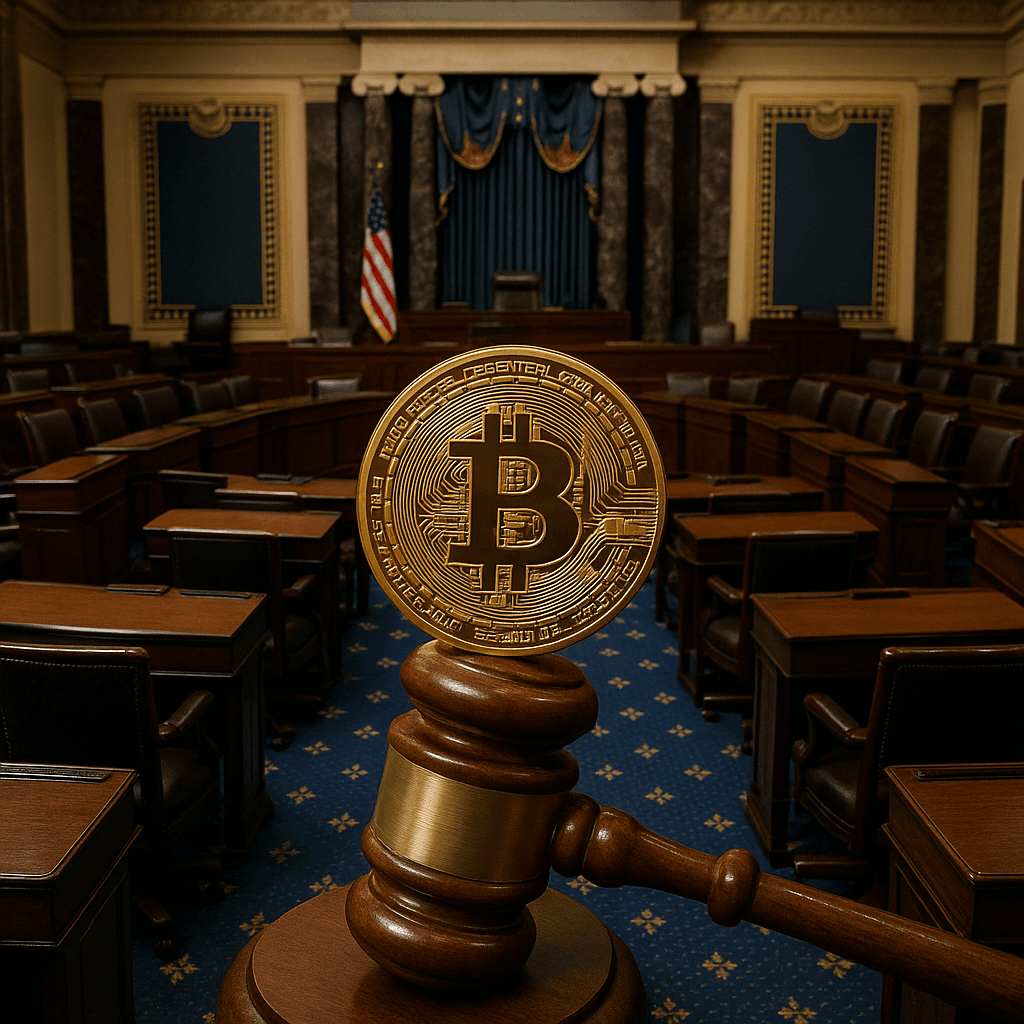
Negotiations in the U.S. Senate over a landmark cryptocurrency regulation bill are continuing despite the ongoing federal government shutdown, with lawmakers from both parties signaling cautious optimism that a bipartisan framework could be finalized before the year ends.
The talks, which have carried on largely uninterrupted amid widespread federal furloughs, reflect the growing urgency among policymakers to establish clear rules for the digital-asset sector. Industry leaders and investors say that without comprehensive oversight, the United States risks ceding ground to global competitors with more defined regulatory regimes.
Core provisions near completion
According to people familiar with the matter, roughly 90% of the bill’s key provisions have been settled. The Senate crypto regulation bill seeks to delineate the oversight responsibilities of the Securities and Exchange Commission (SEC) and the Commodity Futures Trading Commission (CFTC) — a point that has long divided regulators and lawmakers.
Under the emerging framework, the CFTC would oversee cryptocurrencies that function primarily as commodities, while the SEC would regulate tokens deemed to meet the characteristics of securities. Lawmakers are also negotiating guardrails for stablecoins, including reserve requirements and mandatory audits, to prevent market instability and consumer losses.
The bill is being shepherded by Senator John Boozman (R-Ark.), ranking member of the Senate Agriculture Committee, alongside Senator Debbie Stabenow (D-Mich.), its chair. Both senators have previously co-sponsored legislation aimed at giving the CFTC greater authority over spot crypto markets.
Bipartisan focus amid legislative gridlock
While the shutdown has slowed progress across several federal agencies, congressional offices remain operational, allowing negotiations on the crypto bill to continue. Analysts say that bipartisan momentum — and a shared recognition of crypto’s economic significance — has insulated the talks from broader political gridlock.
“The continuity of these discussions during a shutdown underscores how seriously lawmakers now take digital-asset regulation,” said Emily Parker, managing director at crypto research firm Delphi Insight. “There’s a sense that the window for the U.S. to lead is narrowing.”
The renewed focus follows a series of enforcement actions by the SEC against major exchanges, including Binance and Coinbase, which critics say highlight the absence of consistent federal rules. Industry advocates argue that a unified framework could attract institutional investment and reduce the regulatory uncertainty that has plagued the sector.
Global pressure and investor implications
Globally, jurisdictions such as the European Union and the United Kingdom have already enacted comprehensive crypto legislation, intensifying pressure on the U.S. to follow suit. The Markets in Crypto-Assets (MiCA) regulation, set to take effect in 2024, has become a benchmark for stablecoin oversight and consumer protection.
“Investors are watching Washington closely,” said Marcus Liu, a digital-asset strategist at Global Markets Advisory. “If the Senate can deliver a workable regulatory model, it could restore confidence in U.S. crypto markets and encourage capital inflows that have drifted overseas.”
For retail investors, the bill promises clearer definitions of which tokens qualify as securities and the obligations of trading platforms. For institutional players, it could provide a legal foundation for product innovation, from exchange-traded funds to tokenized assets.
Timing and political outlook
Despite the shutdown, aides familiar with the negotiations said the goal remains to introduce the final draft before the end of the current congressional session. Whether it can clear both chambers, however, may depend on how quickly lawmakers can reconcile it with the House-passed Clarity for Digital Tokens Act.
If successful, the measure would represent the most significant federal crypto legislation to date — a step that industry participants say is essential for restoring U.S. competitiveness. Still, lingering disagreements over stablecoin regulation and the extent of SEC oversight could delay a vote until early 2026.
Outlook: Regulatory clarity within reach
For an industry long defined by volatility and regulatory uncertainty, the Senate’s continued work on the crypto regulation bill signals a turning point. Even amid a government shutdown, lawmakers appear determined to provide a framework that balances innovation with investor protection.
If the Senate delivers on that promise, analysts say it could mark the moment when the United States reasserts its leadership in the digital-asset economy — and brings long-awaited clarity to one of finance’s fastest-evolving frontiers.